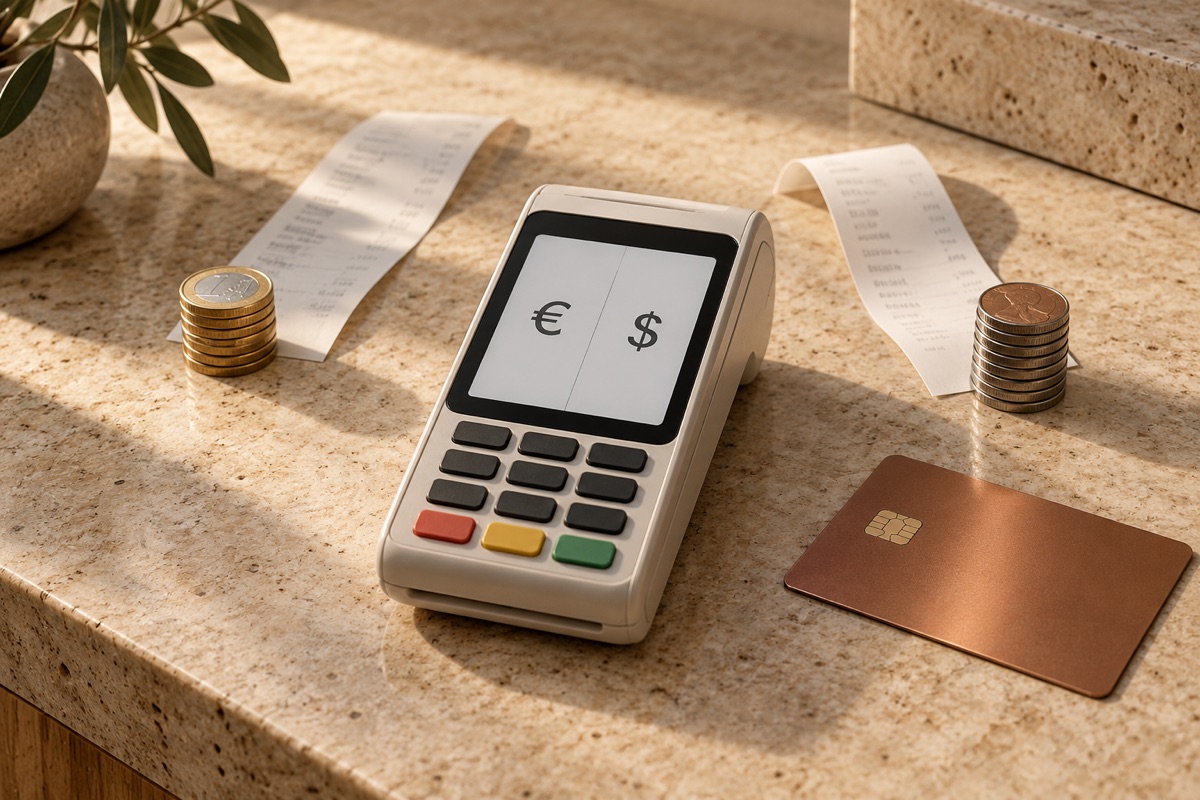
A card terminal abroad offers two buttons: pay in the shop’s currency or pay in your card’s currency. The familiar currency looks reassuring. It does not, by itself, tell you which option costs less.
Dynamic currency conversion (DCC) changes who converts the payment. This guide shows how to compare the two routes using a fully hypothetical €100 purchase. It is not a live exchange-rate quote or a test of a particular card.
What the currency choice actually changes
With DCC, the merchant or ATM operator offers a conversion into your card’s billing currency. If you choose the local currency instead, the transaction is submitted in that currency and your card’s conversion arrangements apply. Visa says the offer should show both currency amounts, the exchange rate and any additional fee or markup. The choice should be yours, not preselected on your behalf. Source: Visa’s DCC explanation.
These are two routes to paying the same bill. Compare their final costs in one currency; do not compare a euro amount directly with a dollar amount or treat a familiar currency symbol as a price guarantee.
A €100 purchase, worked through
Assume the terminal offers to convert a €100 bill to $113. Separately, assume the local-currency route would use $1.08 per euro and your issuer would add 2% to that converted amount. Assume no other charges on either route. These inputs are invented to explain the calculation, not representative market prices.
| Input or result | Terminal conversion | Local-currency route |
|---|---|---|
| Shop’s bill | €100 | €100 |
| Conversion | $113 quoted | €100 × $1.08 = $108 |
| Assumed issuer charge | $0 in this example | 2% × $108 = $2.16 |
| Final cost | $113.00 | $110.16 |
The local-currency route is $2.84 cheaper under those assumptions. Relative to its $110.16 total, the terminal route costs about 2.58% more: $2.84 ÷ $110.16 × 100. That comparison percentage is different from the terminal’s implied difference against the $108 conversion-only baseline.
The distinction matters. Calling the difference “a 4.63% fee” would skip the issuer charge and confuse a benchmark comparison with a separately billed fee. Against $108, the $113 offer is 4.63% higher; against the actual assumed alternative of $110.16, it is 2.58% higher.
Find the break-even point before declaring a winner
In this example, how high could the local-route issuer percentage become before its total reaches $113? Solve $108 × (1 + p) = $113. The answer is p = $113 ÷ $108 − 1, or approximately 4.63%.
At a 0% issuer charge the local route costs $108; at 2% it costs $110.16; at 5% it costs $113.40. In the last constructed scenario, the $113 terminal quote would be lower. This is a sensitivity test, not a claim that your card charges any of these percentages.
Local-route total = local bill × card conversion rate × (1 + issuer percentage) + other local-route charges
DCC-route total   = terminal’s home-currency quote + charges not already included
Difference       = DCC-route total − local-route total
A positive difference means the local route is cheaper under the inputs entered. A negative difference means the DCC route is cheaper. Include each charge once: do not add a markup again if it is already included in the quoted total. Our guide to fees added or deducted explains the same double-counting problem in transfers.
Why the final statement may differ from an estimate
Mastercard describes its currency converter as indicative. Your bank may use a different rate or impose additional charges; timing can depend on authorization or processing. Mastercard also states that its conversion rates do not apply when the merchant or ATM operator converts the transaction. A calculator result therefore helps build an estimate but is not proof of your final card bill. Source: Mastercard currency converter notes.
The worked example assumes no issuer charge on the DCC route only to keep the arithmetic visible. Check your card’s terms rather than assuming payment in your billing currency eliminates every cross-border charge. If a charge is uncertain, record it as unknown and compare a range; do not silently enter zero.
What to record at the terminal
- The original bill and its local currency.
- The offered converted total, exchange rate and stated markup.
- The currency you actually selected and the receipt confirming it.
- Your issuer’s applicable conversion and fee terms, followed by the settled statement amount.
For a €100 bill, a settled total of $110.16 corresponds to an all-in effective cost of $1.1016 per euro. That is a useful comparison measure, but it does not identify which part came from conversion and which from separate fees. Keep the receipt and fee breakdown so the difference can be explained.
If the required DCC information is missing or the choice feels pressured, Visa recommends declining the conversion and reporting the situation to the issuer. A clear choice and a comparable total matter more than the apparent convenience of seeing a familiar currency.
What this example cannot establish
It cannot rank cards, predict the exchange rate when a payment settles, or prove that every DCC offer is more expensive. It also excludes cash withdrawals, where separate ATM or cash-advance charges may change the comparison. Use the actual transaction terms and treat an unknown charge as a limitation, not a saving.
Research note: Official network guidance reviewed on 15 October 2026. All example amounts are constructed; calculations were checked independently of the source guidance. The lead image is an original AI-generated editorial illustration, not a photograph of an actual terminal offer. See our methodology or send a correction.