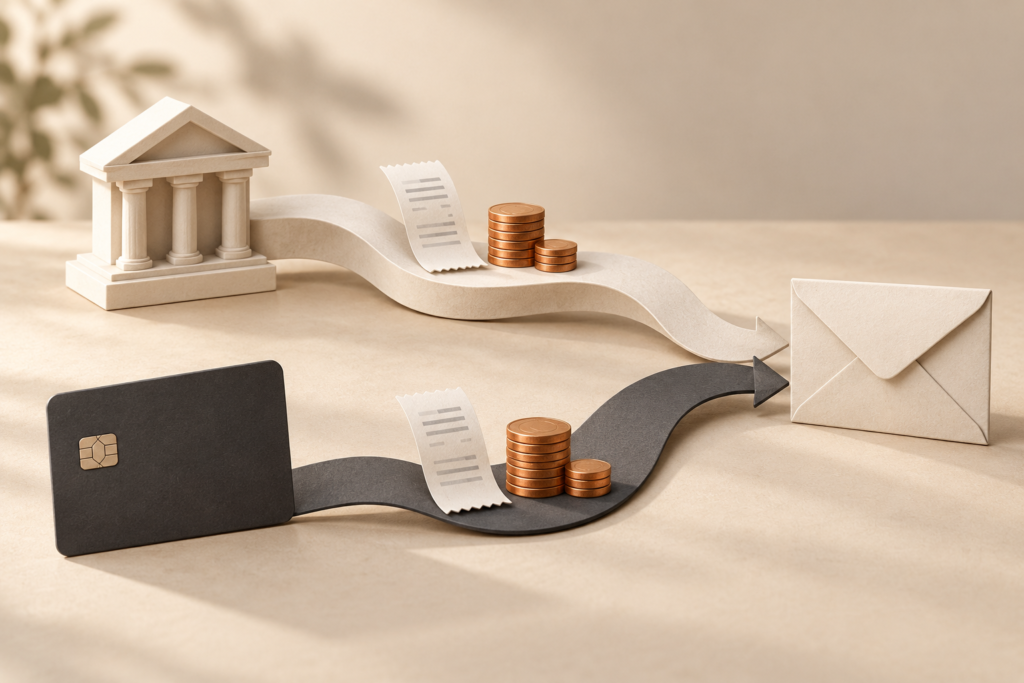
Every transfer journey needs a finish line for a useful cost comparison. For someone paying a bill from a bank account, receiving a token in a wallet is an intermediate step. The useful question is how much spendable money reaches the required destination, and when.
The 19 October BIS Working Paper 1385 edition compares banks, fintech transfer services and stablecoin routes. Its underlying manuscript is dated 14 September. The authors examine currency pricing and explicit charges; the accompanying discussion cautions that samples and cost coverage are not consistently aligned. It does not establish one cheapest route for every customer.
Map the transfer journey from funding to destination
Before comparing prices, write down a complete instruction: “I can spend $1,000 in total, and the recipient needs euros available in this bank account by this deadline.” Keep the funding method, destination and quote time consistent. A cash pickup, wallet balance and bank deposit may solve different problems.
The World Bank’s remittance methodology treats its observations as dated snapshots, tracks exchange-rate margins separately from transfer fees, and notes that some recipient charges are not captured. A published comparison is therefore a research starting point, not a substitute for a current executable quote.
A ten-cent network charge would not settle the comparison
Hypothetical worked example—not live quotes. The following invented routes illustrate accounting only. They do not represent typical bank, fintech or stablecoin prices. Both use a fixed $1,000 total sender budget and an assumed €0.90 per dollar conversion rate, with no other charges.
| Step | Route A | Route B |
|---|---|---|
| Starting budget | $1,000 | $1,000 |
| Charges deducted before conversion | $5 | $4 acquisition charge + $1 network charge |
| Amount converted | $995 | $995 |
| Euros before final deduction | €895.50 | €895.50 |
| Final withdrawal or receiving charge | €2 | €8 |
| Recipient’s usable euros | €893.50 | €887.50 |
Both routes start with the same budget and convert the same amount. Route A leaves €6 more because the final deduction differs. Looking only at Route B’s $1 network charge would miss that result. Even reducing that charge to $0.10 would add only €0.81, leaving Route B at €888.31 under these assumptions.
Changing the exchange rate or another charge could reverse the ranking. The example supplies a method, not a provider recommendation. Keep charges in their original currencies until the conversion step; adding a dollar fee directly to a euro fee would produce a meaningless total.
Ask for the amount at the finish line
Request the total debit, recipient currency, net amount available, delivery estimate and any charges excluded from the quote. Record which amounts are guaranteed and which can change before completion. If the destination is a wallet but the bill requires a bank payment, include the remaining conversion and withdrawal steps.
Our practical test is simple: can both offers complete the same instruction? If one leaves an unpriced step, record that uncertainty rather than assigning it a zero. Compare support and recovery arrangements separately from price; a smaller fee does not answer what happens if the payment goes wrong.
For a closer look at deductions, see why the recipient can receive less than expected. For the sender’s side, see how the funding method changes the cost.
Sources accessed 22 October 2026. Numerical and timing scenarios are hypothetical, not live quotes or delivery promises. Finance404 provides financial education, not personal financial advice.